DETERMINATION OF RESISTANCE TO THERMAL SHOCK-LIQUID TO AIR-20 C TO 170 C-
Model Number : TS20170
Liquid to air thermal shock testing applies thermal shocks to test samples by alternately immersing them in a high- and low-temperature liquid and air medium. The expansion and contraction caused by the temperature variation generate stress from differences in the expansion rates of parts made of different bonded materials. Repeated stress causes accumulated fatigue, leading to cracks and rupturing. The repeated action of stress causes accumulation of material fatigue, sometimes leading to rupturing at a lower strength than the static strength. Repeated stress can also cause coatings to peel and screws to loosen. Liquid to air thermal shock tests require caution since it can apply temperature variations that are excessively large in comparison to the various temperature variations encountered in the market, and so doesn't simulate market failures. But it is an effective thermal shock-based method of finding weaknesses.
DETERMINATION OF RESISTANCE TO THERMAL SHOCK-LIQUID TO AIR-20 C TO 170 C-
Liquid to air thermal shock testing applies thermal shocks to test samples by alternately immersing them in a high- and low-temperature liquid and air medium.
- The expansion and contraction caused by the temperature variation generate stress from differences in the expansion rates of parts made of different bonded materials. Repeated stress causes accumulated fatigue, leading to cracks and rupturing.
- The repeated action of stress causes accumulation of material fatigue, sometimes leading to rupturing at a lower strength than the static strength.
- Repeated stress can also cause coatings to peel and screws to loosen.
- Liquid to air thermal shock tests require caution since it can apply temperature variations that are excessively large in comparison to the various temperature variations encountered in the market, and so doesn't simulate market failures. But it is an effective thermal shock-based method of finding weaknesses.
Test equipment
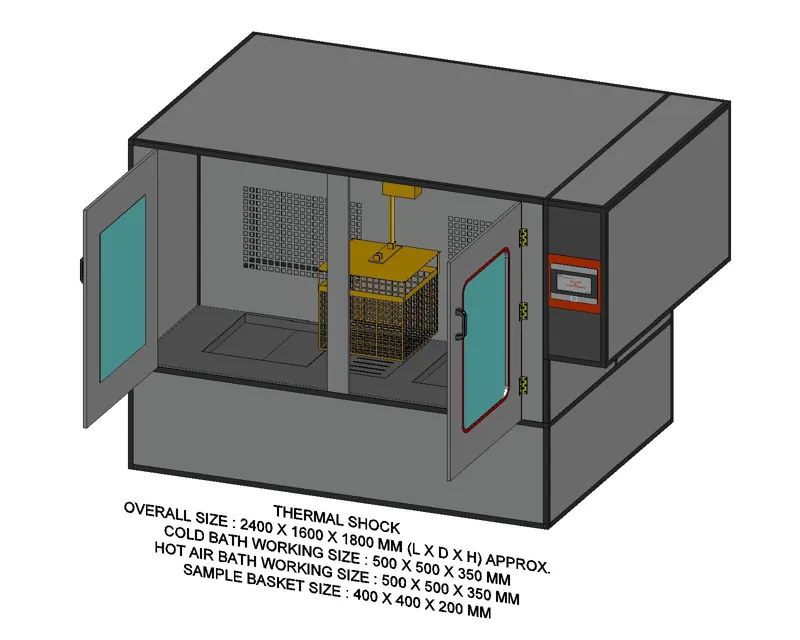
- As shown in the diagram, the test equipment has a high-temperature chamber and low-temperature chamber. An suitable mechanism places the specimen basket in each chamber alternately, subjecting it to thermal shock.
- liquid medium used is distillated water for cooling
- Usage temperature range(in water): 10 °C to room temperature
- Hot air generated in oven for heating medium
- Usage temperature range(in air): 50 °C to 200 °C
- Test description
- The test sample is placed in a stainless steel specimen basket, then placed in the chambers by an suitable mechanism to apply low temperature-high temperature thermal shock.
Construction Details:
- CE Certified
- Chamber equipped with PLC & Touch screen HMI system
- Highly accurate Individual control Loop for precise control of temp
- Interior fabricated from Mirror Polished Stainless Steel (S.S.-304 Grade).
- Exterior body is also fabricated from Mild Steel material with powder coating
- Full size polycarbonate sheet inner door to inspect samples without affecting the chamber temperature.
- Properties of polycarbonate sheet door (Unbreakable, Un-stretchable, High temperature resistant, Robust, Air tight and Transparent)
- Electrical wiring as per CE Compliance
- Chamber illumination by LED light.
- User friendly and tactfully designed chamber door and locking mechanism
- Aesthetic outer appearance and high quality
Following advance features are available:
- Equipped with 7" Touch screen HMI Controller and PLC System
Heating & Cooling System:
Long lasting SS tubular heaters used as heating element. The stainless steel fins provided to ensure better heat transfer.
Hermetically sealed compressor CFC free compressor (134 A gas) coupled with evaporation coil and condenser. All refrigeration components like expansion valve, driers, oil separators, pressure gauges and vibration eliminators provided. Reputed company make refrigeration system such as Emerson/Kirloskar Make
| Temperature Range High | High-temperature exposure(in air): 50 °C to 200 °C |
|---|---|
| Temperature Range Low | Low-temperature exposure(in water): 10 °C to room temperature |
| Test Area | High-temperature exposure(in air):500 X 500 X 350 MM |
| Test Area | Low-temperature exposure(in water):500 X 500 X 350 MM |
| Sample basket | 400 X 400 X 200 mm |
| Sample basket material | Stainless steel S.S. - 304 perforated sheet |
| Inner chamber material | Stainless steel S.S. - 304 Mirror Polished |
| Outer Chamber | mild steel with powder coating in attractive sheads |
| Insulation | Puff insulation for cooling and cerawool for heating |
| Insulation thickness | 75mm |
| Controlling System | Highly advanced Touch screen HMI & PLC Control system |
| Display | Digital LCD Display (7" Screen Size) |
| Temperature Accuracy | ± 0.5°C or better |
| Temperature sensor | Pt - 100 sensor |
| No. of Temperature Sensors | 02 nos |
| Observation door | Polycarbonate sheet door to inspect test samples without disturbing chamber operation |
| Illumination | LED Light |
| Power Supply | 230 Volts, 50 HZ, Single Phase, AC Supply |
| Overall size | 2400 X 1600 X 1800 mm(L X B X H in mm) |