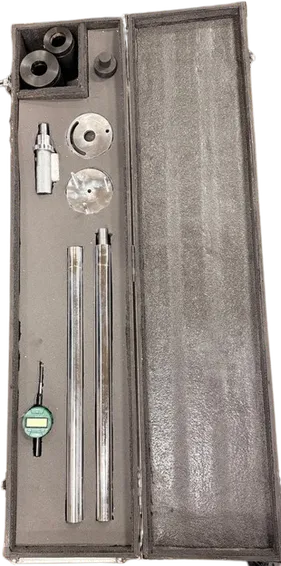
BRE SCREED TESTER-WITH DIAL GAUGE
Model Number : EIE-BRE-DG
The BRE Screed Tester is designed to measure the soundness of a sand and cement floor screed. The device consists of a 1 m long, cylindrical guide rod, along which an annular weight of 4kg (or 2kg) travels when released. At the bottom of the guide rod the weight strikes the collar of a case-hardened steel anvil which transmits the impact to the surface of the screed. Four successive impact blows on the same spot are sufficient to test the soundness of the screed. The depth of indentation is measured with an electric or mechanical depth gauge. At the end of taking readings, a number of statistical values are then calculated and printed from the data. Guidance is given on the use of the screed tester for testing floating screeds using a 2 kg annular weight in place of the 4 kg weight normally used.
Purpose:
The BRE (Building Research Establishment) screed test is a, [often called a "drop hammer test," evaluates the in-situ surface soundness and compaction of sand/cement screeds by measuring indentation depth from a 4kg hammer dropped four times. It determines if a screed is durable enough for traffic, with passes generally requiring <3mm-5mm indentation (per BS 8204-1)The test helps determine if the screed can withstand service conditions without breaking down, preventing issues with floor finishes, and is used to determine if the screed is fit for purpose
Key Aspects of the BRE Screed Test:
Methodology: A 4kg weight is dropped four times in the same spot, striking an anvil resting on the screed surface.
Measurement: A micrometer is used to measure the depth of the resulting indentation.
Acceptance Criteria (BS 8204-1):
Category A (Heavy Duty): <3mm.
Category B (Medium Duty): <4mm.
Category C (Light Duty): <5mm.
Test Timing: Testing is usually conducted when the screed is at least 14 to 28 days old.
Sample Rate: Generally, at least 3 tests are required for every 20-25 square meters.
Applicability: Designed primarily for sand and cement screeds to identify issues like weak, crumbling, or poorly compacted materials