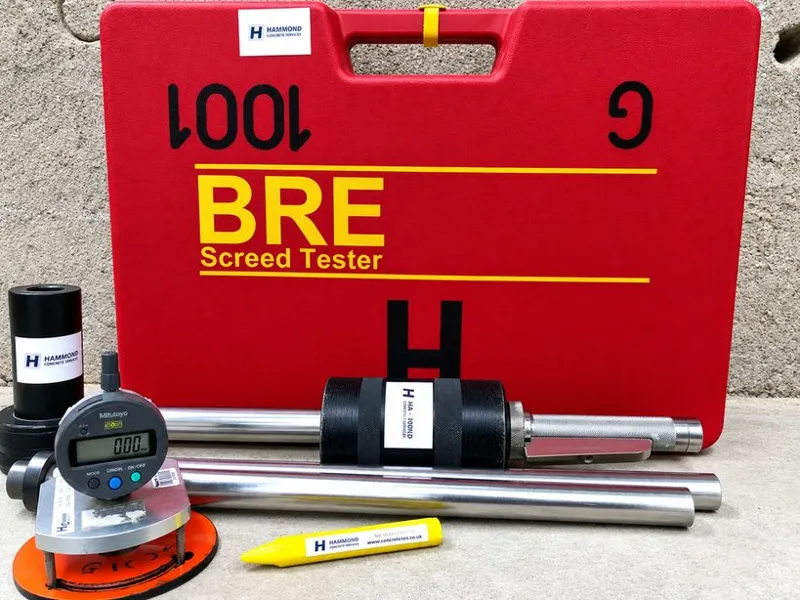
BRE SCREED TESTER WITHOUT DIAL GAUGE
The BRE Screed Tester is designed to measure the soundness of a sand and cement floor screed. The device consists of a 1 m long, cylindrical guide rod, along which an annular weight of 4kg (or 2kg) travels when released. At the bottom of the guide rod the weight strikes the collar of a case-hardened steel anvil which transmits the impact to the surface of the screed. Four successive impact blows on the same spot are sufficient to test the soundness of the screed. The depth of indentation is measured with an electric or mechanical depth gauge. At the end of taking readings, a number of statistical values are then calculated and printed from the data. Guidance is given on the use of the screed tester for testing floating screeds using a 2 kg annular weight in place of the 4 kg weight normally used.
Dense floor screeds which on visual inspection appear to be sound, i.e.able to withstand imposed loads and traffic, may in fact be sub-standard.Specifications often state that the cement /sand screed should be semi-dry, a consistency which when manually compressed may result in the lower layers being insufficiently compacted. This may cause the screed to fail under the impact of heavy traffic or furniture movement. Subsequent remedial work on the screed is often costly and time consuming.
The tester is designed to measure screed soundness as early as 14 days after laying. The device consists of a 1 meter long, cylindrical guide rod, along which an annular weight of 4 kg travels when released. At the bottom of the guide rod the weight strikes the collar of a case-hardened steel anvil which transmits the impact to the selected area of the screed.
Research has shown that four successive impact blows on the same spot are sufficient to test the soundness of the screed. Any area where the impacts produce an indentation of 3 mm or less can be considered sound, according to current data. Where the indentations are greater than 5 mm the screed is considered and may fail when in use. BS 8203 gives guidance on the type of use of a floor and its associated acceptance limits after four drops of the weight. The depth of indentation is measured with a purpose-made mechanical gauge or a more sophisticated direct-reading digital electronic gauge which is available if required.
Specification :
- Drop weight (normal screeds): 4 kg
- Drop weight (floating screeds): 2 kg
- Drop height: 1000 mm
- Contact area of anvil: 500mm2
- Overall dimensions of carrying case: 515 mm x 375 mm x 125 mm
- Weight of BRE screed tester in case: 11.75 kg
- Complete kit with certificate of conformity